
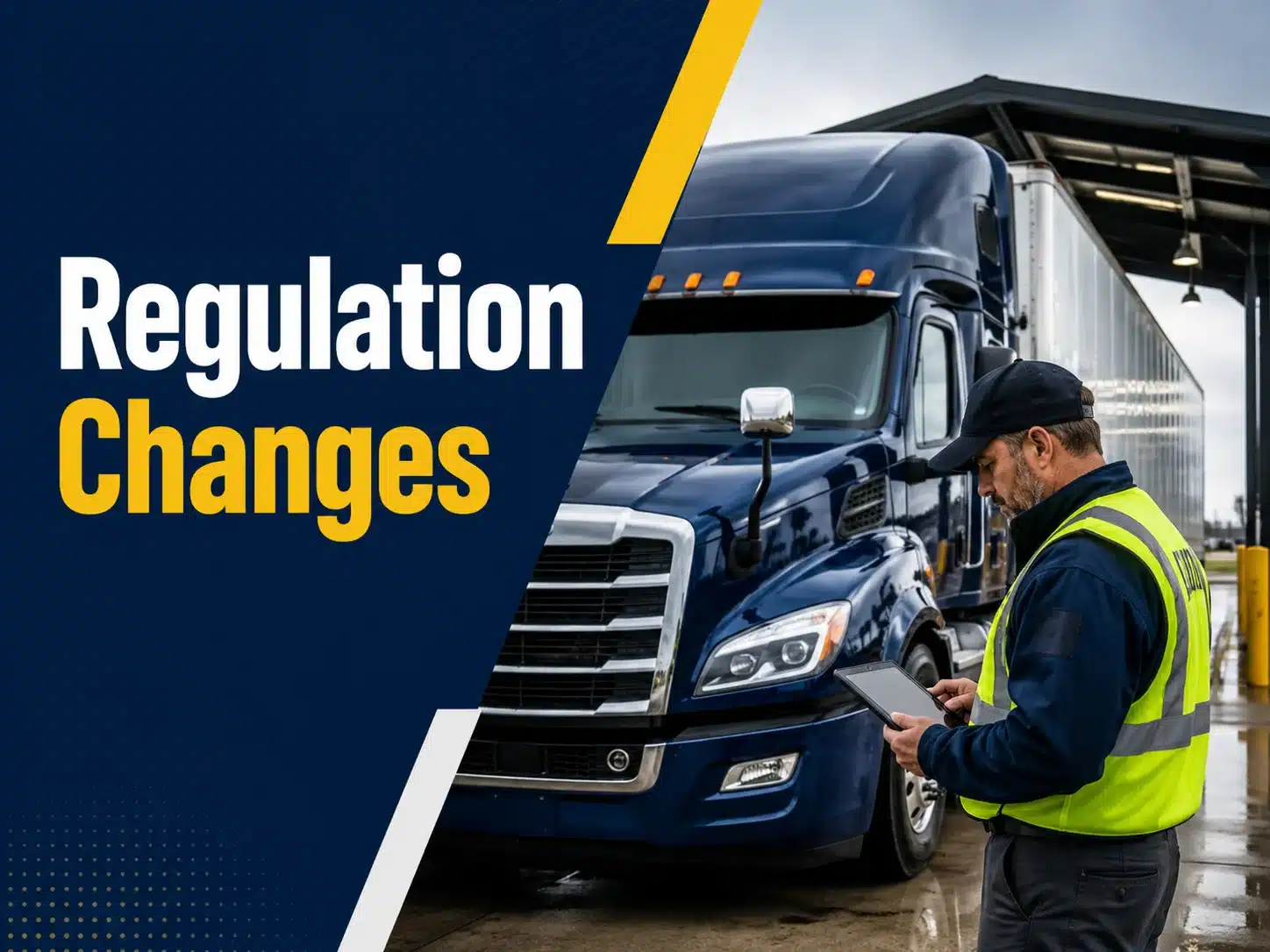
The Federal Motor Carrier Safety Administration (FMCSA) has recently published three additional regulatory changes. This is part of their program to remove obsolete rules and reduce compliance costs without impacting safety. The most recent changes are discussed below and become effective July 22, 2026:
Roadside Inspection Forms
FMCSA has eliminated the requirement that motor carriers and intermodal equipment providers sign and return a completed roadside inspection form to the issuing State agency. FMCSA is aware that not all issuing State agencies require the return of these reports, and that requiring motor carriers and intermodal equipment providers to submit these reports to a State that does not require, or even request, the return of the form creates an unnecessary burden. Through this change, completed forms will only be returned to those States that request them. This action is in response to a petition for rulemaking from the Commercial Vehicle Safety Alliance (CVSA).
One commenter suggested that FMCSA publish a list of those States that require the return of the completed roadside inspection report. FMCSA said they will not be compiling this list. The Agency advises motor carriers to continue to check and comply with the requirements of the States in which they operate.
CDL Holder Self Report Traffic Violations
FMCSA amends the regulations requiring commercial driver’s license (CDL) holders to self-report motor vehicle violations to their State of domicile. With the implementation of the exclusive electronic exchange (EEE) of violations between State Drivers Licensing Agencies (SDLAs) in 2024, self- reporting is no longer necessary.
The National Association of Pupil Transport (NAPT) commented that their members did not believe that the mandate was being applied consistently across States, and that several States do, in fact, continue to rely on self-reporting. NAPT requested a clear and consistent direction for what to do if the self-reporting requirement were eliminated from the FMCSR, but a driver’s State of domicile still requires the report. It also requested the creation of a resource that would list all of the States still requiring driver reports.
FMCSA agrees with the comment from NAPT that having the information on which States continue to require drivers to notify their SDLAs of convictions outside of their State of domicile would be helpful. However, FMCSA will not be compiling this list. The Agency advises CDL holders to continue to check and comply with the requirements of their State of domicile. Nothing in this rule absolves a CDL holder from having to comply with a state requirement if that requirement exists.
ELD Operating Manual
FMCSA is removing the requirement for a copy of the electronic logging device (ELD) operator’s manual to be kept in a commercial motor vehicle (CMV). Drivers are required to understand the operation of the ELD to ensure the accuracy of their electronic records of duty status, and to present this information during inspections by enforcement officials. There is no readily apparent benefit to continuing to require that the user’s manual be in the CMV.
Twenty-four comments were received after this change was proposed. Only four of those were against the change. The dissenters felt that drivers and law enforcement may not know how to access an electronic version of the instructions stored in the ELD device.
FMCSA has a copy of each user manual on file as part of the documentation process for ELD registration. All of these manuals are readily available to motor carriers, drivers, enforcement personnel, and the public through FMCSA’s list of approved ELD devices on its website, https://eld.fmcsa.dot.gov. Finally, while this regulatory change removes the requirement to carry a printed user manual, it does not forbid motor carriers or drivers from continuing to carry a user’s manual for their ELD.
Recent Comments