
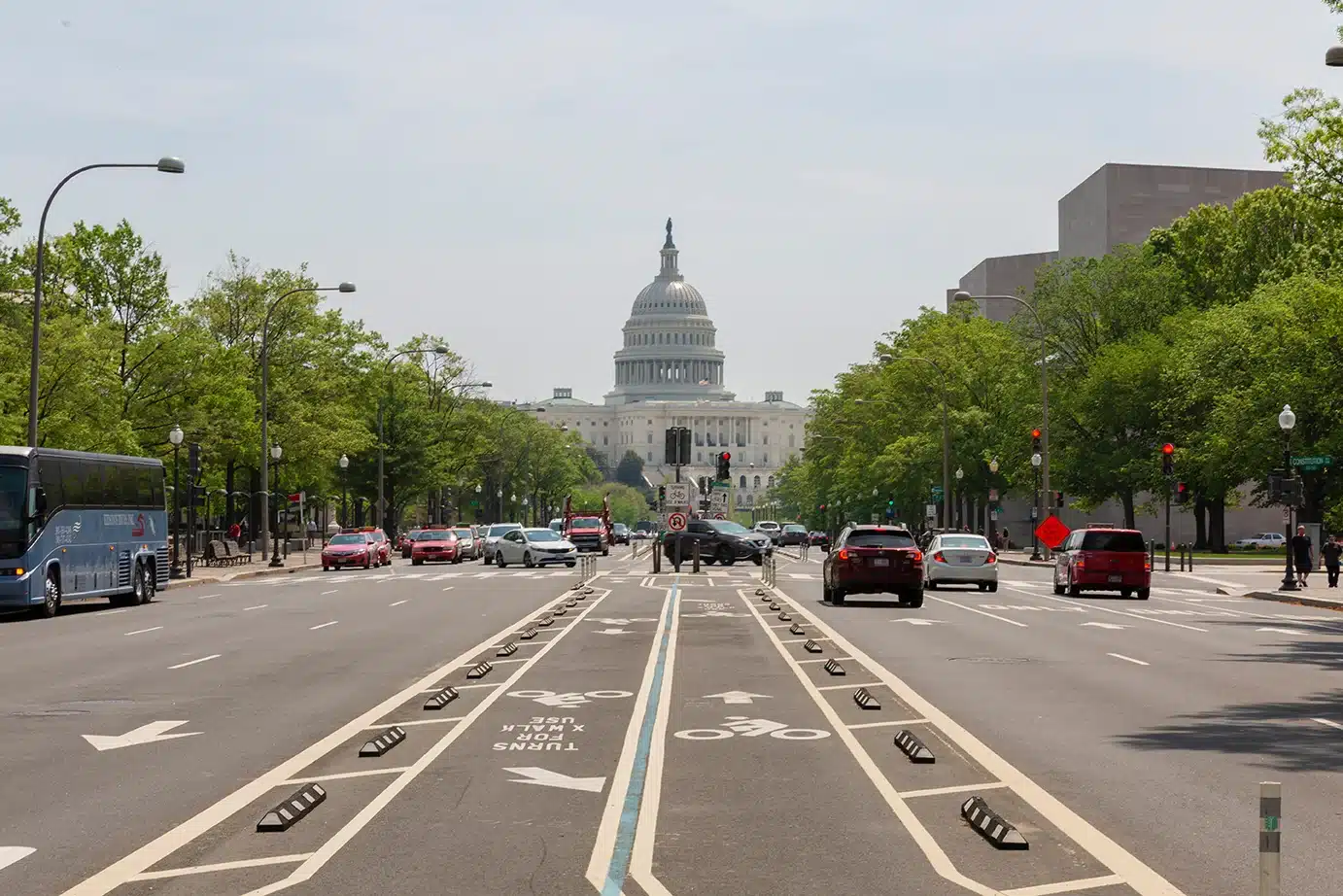
The House of Representatives is working on the next surface transportation bill titled the Build America 250 Act. This Bill will reauthorize federal surface transportation programs and it currently has a September deadline. What follows is a discussion of some of the provisions.
Pulsating Brake Lights
Federal regulations specify that brake lights are to be red and steady burning. Alternate devices require a waiver from the Federal Motor Carrier Safety Administration. FMCSA has granted several waivers to allow pulsating brake lights. These waivers are for specific motor carriers and lighting manufacturers. A proposal was made to include language in the Bill which would alter the current standards to allow pulsating brake lights universally which would negate the need for a waiver. This proposal prompted a discussion in the House Transportation and Infrastructure Committee over whether Congress or safety regulators should dictate vehicle highway standards.
Rep. Rick Larsen (D-WA), the committee’s ranking member, argued the measure would strip authority from federal safety experts and disrupt active safety standard evaluations. The amendment “would weaken the standard for the transportation rulemaking committee to determine if pulsating light systems are safe,” Larsen said. “It’s not the job of Congress to determine what complies with Federal Motor Vehicle Safety Standards. These determinations are made by neutral experts at the National Highway Traffic Safety Administration,” he added. The amendment was not included in the Bill. Ultimately it will be FMCSA that decides what brake light devices are acceptable.
Increased Weight Limit
An amendment was added to the Bill to establish a voluntary pilot program allowing states to raise gross vehicle weight limits on federal interstate roads. Participating states could increase the limit from 80,000 pounds to 91,000 pounds. However, trucks taking advantage of the increased weight limit must have six axles.
Proponents of the increase cite increased productivity which would allow trucks to haul the same amount of cargo with fewer trips. Also, 40 states currently have increased weight limits on non-federal roads which forces trucks to avoid interstate highways if they’re over 80,000 pounds. Mike Collins (R-GA) argued that the capabilities of safety technologies, like anti-lock braking systems, automatic anti-rollover devices, and disc brakes, far outpace the outdated limits that were placed on commercial vehicles more than 40 years ago.
“Increasing truck weight limits raises serious concerns,” countered Representative Salud Carbajal (D-CA), who listed more severe crash impacts and greater risk for passenger vehicles sharing the road as consequences. Rep. Hank Johnson cited a Washington State study that found 91,000-pound trucks were 47% more likely to be involved in a crash than standard loads.
Support for Safety
According to the Commercial Vehicle Safety Alliance (CVSA) “The BUILD America 250 Act lays the groundwork for long-term improvements in commercial motor vehicle safety by investing in enforcement, training, compliance and innovation,” said CVSA Executive Director Collin Mooney. In a letter submitted to leadership of the U.S. House Committee on Transportation and Infrastructure, the Alliance praised the bill for:
- Providing critical funding through the Motor Carrier Safety Assistance Program (MCSAP) and other discretionary grant initiatives
- Expanding MCSAP spending eligibility
- Supporting certification training for commercial motor vehicle inspectors through improvements to the Enforcement Training and Support Grant
- Requiring minimum knowledge standards for new motor carriers and improvements to the New Entrant Safety Assurance Program
- Improving hazardous materials training for inspectors, first responders and industry personnel
- Expanding eligibility for Commercial Driver’s License Program Implementation Grants to Puerto Rico and the U.S. Virgin Islands
- Strengthening oversight of exemptions from federal regulations
- Improving the electronic logging device (ELD) certification process
- Addressing challenges posed by chameleon carriers
- Improving lithium battery transportation safety by establishing registration and other requirements
- Establishing a framework for commercial motor vehicles equipped with autonomous driving systems
Lease Purchase Agreements
Included in the Bill are provisions that would establish federal oversight over “lease-purchase” or “lease-to-own” agreements. Over the years some of these agreements have been labeled “predatory” because they promise ownership but leave drivers saddled with deductions for fees, insurance, maintenance and truck payments. This provision directs the Secretary of Transportation to issue formal regulations regarding these types of agreements under federal jurisdiction. Leasing companies would be required to fully disclose:
- Weekly compensation for drivers
- Average weekly mileage and the schedule for drivers
- The number of drivers who enter into the arrangement each year
- The number of drivers who complete the lease term
- The number of drivers who buy out a truck
- The average for each deduction category in settlements, including fuel, insurance, registration, maintenance, and escrow.
In January, 2025, a report was issued by the Truck Leasing Task Force. This fifty-one-page report examined all aspects of truck lease-purchase agreements. The introduction to the report states that “The Truck Leasing Task Force (TLTF or the Task Force) began with a range of perspectives on lease-purchase programs, including members who believed lease-purchase programs could provide an important avenue to truck and small business ownership. Over the last year and a half, however, the comments drivers and non-driver industry stakeholders provided in public meetings and submitted to the public docket, as well as data reviewed by TLTF, told a consistent and increasingly troubling story: lease-purchase programs cause widespread harm without offering meaningful scale opportunities for truck and small business ownership.”
The Task Force concluded that “If lease-purchase programs are allowed to continue, they should be subject to a number of conditions that mitigate the inherent power imbalance of motor carriers over drivers and ensure that drivers understand the likely outcomes of the contracts they will be signing.” Many of the Task Force’s recommendations are in the Bill which also authorizes a DOT campaign to increase awareness of how lease-purchase programs work.
Recent Comments