
Last updated: November 12, 2026
The Short Answer
Question: What hazmat rules apply to fleets that carry fuel, gas cylinders or batteries for their work?
Answer: Many construction, landscaping, utility and service fleets carry small amounts of hazmat as “materials of trade” under 49 CFR 173.6. Within its limits, the exception replaces shipping papers, placards and formal hazmat training with simpler packaging, marking and driver-awareness rules. Go over a limit and the full Hazardous Materials Regulations apply. A September 2026 rule raised the lithium battery limits.
This guide explains how the exception works for fleets, what changed for lithium batteries in 2026, how diesel fuel is treated, and when a work truck moves into full hazmat compliance. It is written for safety and fleet leaders at companies that operate commercial motor vehicles, not for individual drivers.
When hazmat rules apply to fleets outside the hazmat business
Hazmat rules are not only for tanker carriers. The Pipeline and Hazardous Materials Safety Administration (PHMSA) writes the Hazardous Materials Regulations in 49 CFR Parts 171–180, and they reach hazardous materials carried on a company’s own trucks, not only on for-hire carriers. The materials of trade exception exists precisely because private fleets carry these items every day (49 CFR 171.8). The Federal Motor Carrier Safety Administration (FMCSA) rules come into play when a vehicle carries placarded hazmat, as explained below.
For a fleet that is not in the transportation business, the usual question is not whether hazmat is on the truck. Gasoline cans, propane and acetylene cylinders, cleaning chemicals and battery packs are common. The question is whether those items fit inside the materials of trade exception or go beyond it.
What is the materials of trade exception?
A material of trade is a hazardous material carried on a motor vehicle for one of three purposes defined in 49 CFR 171.8: to protect the health and safety of the operator or passengers; to support the operation or maintenance of the motor vehicle, including its auxiliary equipment; or, by a private motor carrier, in direct support of a principal business that is other than transportation by motor vehicle.
That third purpose covers most construction, landscaping, lawn care, tree service, utility and service fleets. When a material of trade is carried in compliance with 49 CFR 173.6, it is not subject to the other requirements of the Hazardous Materials Regulations beyond those the section sets out or references. In practice, that means no shipping papers, no placards and no formal hazmat employee training for those items.
Some materials can never be materials of trade. 49 CFR 173.6(a)(5) excludes self-reactive materials, materials that are poisonous by inhalation, and hazardous waste.
Materials of trade quantity limits
The exception is built on per-package limits by hazard class and a total weight limit for the vehicle. The core limits in 49 CFR 173.6, current as of October 1, 2026, are:
| Material | Limit per package or cylinder | Section |
|---|---|---|
| Class 3, 8, 9 and Division 4.1, 5.1, 5.2, 6.1, Packing Group I | 0.5 kg (1 pound) or 0.5 L (1 pint) | 173.6(a)(1)(i) |
| Same hazard class list, Packing Group II or III | 30 kg (66 pounds) or 30 L (8 gallons) | 173.6(a)(1)(ii) |
| Division 2.1 or 2.2 gas (for example propane, acetylene, oxygen) | Cylinder gross weight not over 100 kg (220 pounds) | 173.6(a)(2) |
| Division 4.3, Packing Group II or III | 30 mL (1 ounce) | 173.6(a)(3) |
| Lithium cells and batteries (not in equipment) | 30 kg (66 pounds) net per cell or battery | 173.6(a)(7)(iii) |
| All materials of trade on one motor vehicle | 200 kg (440 pounds) aggregate gross weight, except lithium batteries and diluted Class 9 mixtures | 173.6(d) |
The packing group is shown on the product’s shipping description and safety data sheet (SDS). If the SDS does not settle it, treat the material as outside the exception until someone qualified confirms it.
Packaging and marking requirements
Inside the exception, packaging and communication rules still apply. Under 49 CFR 173.6(b) and (c):
- Packages must be leak tight for liquids and gases, sift proof for solids, securely closed, secured against shifting and protected against damage.
- Each material must be in the manufacturer’s original packaging or a packaging of equal or greater strength and integrity.
- Gasoline must be in a metal or plastic container that meets the hazmat rules or the OSHA container standards in 29 CFR 1910.106(d)(2) or 1926.152(a)(1).
- Cylinders must meet their packaging and maintenance requirements, and DOT specification cylinders must be marked and labeled.
- A non-bulk package other than a cylinder must be marked with a common name or proper shipping name, plus “RQ” if it holds a reportable quantity of a hazardous substance.
- The operator of the vehicle must be told that the hazardous material is on board, whether it includes a reportable quantity, and what the section requires.
That last requirement is the company’s job. A short written briefing and a simple vehicle checklist are a practical way to show it was done.
Lithium batteries: the 2026 materials of trade change
PHMSA’s final rule “Hazardous Materials: Reducing Burdens on Domestic Companies Using Battery-Powered Equipment in Trades” (91 FR 49345, published August 4, 2026, effective September 3, 2026) raised the lithium battery limits under the exception. According to PHMSA, the change addresses limits that constrained construction, landscaping, mowing, tree service, food service and entertainment companies.
Under the amended 49 CFR 173.6(a)(7)(iii) and (d):
- Spare cells and batteries may be up to 30 kg (66 pounds) net weight each, with up to 500 kg (1,102 pounds) aggregate net weight on a motor vehicle.
- Batteries contained in equipment, such as battery-powered mowers, trimmers and tools, are not held to those weight limits. Individual batteries contained in equipment cannot exceed 30 kg (66 pounds).
- Lithium batteries do not count toward the 440-pound aggregate limit for other materials of trade.
- Every cell and battery, including those in or packed with equipment, must be of a type proven to meet the UN Manual of Tests and Criteria, Part III, sub-section 38.3.
- Batteries must be packed or secured to prevent short circuits, damage from shifting, and accidental activation of the equipment.
- A package of batteries over 30 kg (66 pounds) net weight must carry the Class 9 label and the four-digit UN identification number.
For fleets moving to battery-powered equipment, this is a meaningful change. NTCI covered the rule briefly in its post on 2026 PHMSA hazmat regulation changes; this section shows how it applies on a work truck.
Diesel fuel on work trucks and service vehicles
Diesel fuel is a Class 3 material in Packing Group III, shipped as “UN1202, Diesel fuel, 3, PG III” or “NA1993, Diesel fuel, 3, PG III” (PHMSA interpretation 21-0109, March 14, 2022). Because its flash point is at or above 38 °C (100 °F), diesel may be reclassed as a combustible liquid under 49 CFR 173.120(b)(2) and 173.150(f)(1).
How that plays out on a work truck depends on the container:
- In non-bulk packaging, meaning a capacity of 450 L (119 gallons) or less for a liquid (49 CFR 171.8), a material reclassed as a combustible liquid is not subject to the Hazardous Materials Regulations unless it is a hazardous substance, hazardous waste or marine pollutant (49 CFR 173.150(f)(2)).
- In bulk packaging, over 119 gallons, a combustible liquid remains subject to specific requirements, including shipping papers, marking, identification numbers, placarding, packaging, training and emergency response information (49 CFR 173.150(f)(3)).
- Carried as a material of trade without reclassing, diesel is a Packing Group III Class 3 material, so each container is limited to 30 L (8 gallons, subject to certain limitations) and counts toward the 440-pound total.
- For intrastate carriers, 49 CFR 173.8(c) allows a non-specification metal tank permanently secured to the vehicle, under 119 gallons, for flammable liquid petroleum products, subject to the conditions in 173.8(d).
Fuel transfer tanks and auxiliary tanks are where fleets most often need a second look, because the right answer depends on tank size, how the fuel is described, and whether the operation is interstate or intrastate.
Construction and landscaping vehicles: common examples
These examples apply the rule text to vehicles NTCI’s fleet clients commonly run. Each assumes a private carrier whose principal business is not transportation.
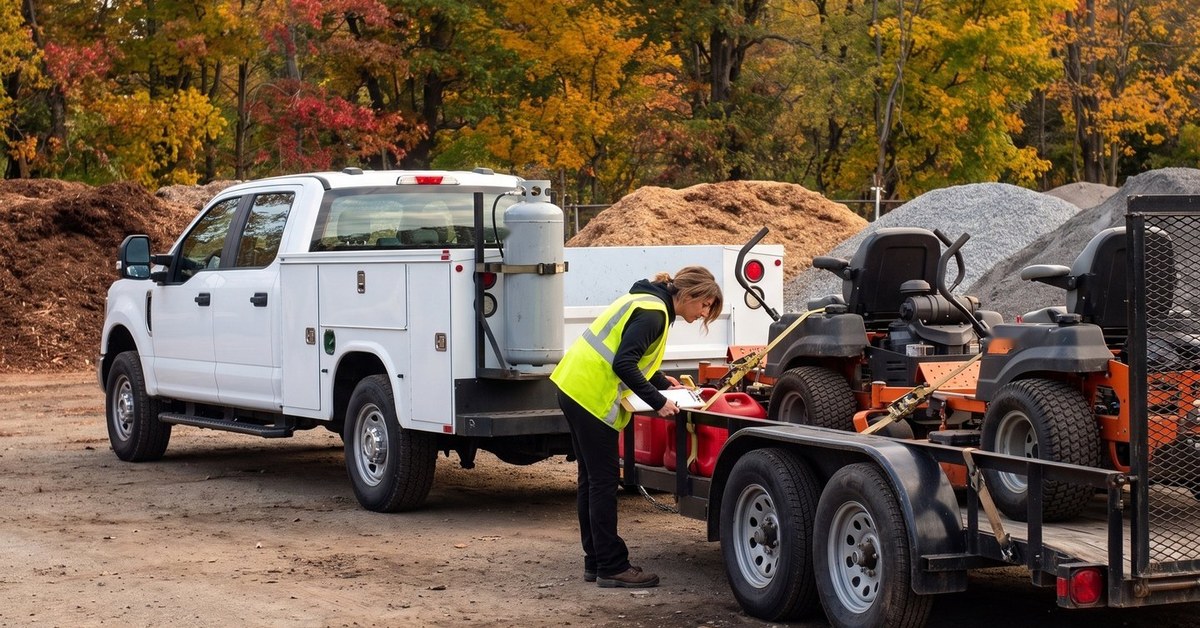
- A landscaping crew truck carrying gasoline for mowers and trimmers. The gasoline goes in metal or plastic cans; if the SDS shows Packing Group II or III, each can may hold up to 8 gallons (subject to certain limitations), and all materials of trade on the truck together must stay within 440 pounds gross.
- The same crew moving battery-powered equipment. Batteries installed in the mowers and trimmers are not weight-limited, except batteries cannot individually exceed 30 kg (66 pounds); spare packs follow the 30 kg (66 pounds) per battery and 500 kg (1102 pounds) per vehicle limits and must be secured against short circuits and shifting.
- A construction or welding truck carrying acetylene and oxygen cylinders. Each cylinder must weigh no more than 220 pounds gross, meet its cylinder requirements, and be secured; the cylinders count toward the 440-pound total.
- A service truck with a diesel transfer tank. Tank capacity, the fuel’s shipping description and interstate or intrastate operation decide which rule applies, as described above.
If any one item goes over its limit, the exception does not cover that material, and the next section applies.
Beyond materials of trade: placards, shipping papers and training
When a load goes beyond the exception, the full Hazardous Materials Regulations apply to it. Three changes matter most for a fleet:
- Placards. Under 49 CFR 172.504, bulk packagings and vehicles containing hazardous materials are placarded per Tables 1 and 2, with an exception for vehicles carrying less than 454 kg (1,001 pounds) aggregate gross weight of Table 2 materials in non-bulk packages (172.504(c)).
- Shipping papers and hazard communication. Packages need full marking and labeling, and the shipment needs shipping papers and emergency response information.
- Training. Under 49 CFR 172.702(a), a hazmat employer must ensure each hazmat employee is trained. Training under 172.704 includes general awareness, function-specific, safety, security awareness, and in-depth security training, as applicable, and must be repeated at least once every three years.
A vehicle that carries hazardous materials in a quantity requiring placards is also a commercial motor vehicle under 49 CFR 390.5, whatever its weight, so the Federal Motor Carrier Safety Regulations apply to it in interstate commerce.
How NTCI supports hazmat compliance for fleets
As part of its DOT compliance services, NTCI provides hazmat training and consulting for companies, covering PHMSA and FMCSA requirements. Hazmat training is not just for drivers: employees who load, unload, prepare, document, package, label, or ship hazardous materials may need it. NTCI’s support can include general awareness, function-specific, security awareness, and safety training, guidance on training frequency and documentation, review of hazmat paperwork, and hazmat security plan review.
NTCI’s consultants average 20+ years of experience, all of them in motor carrier enforcement, and they review what a fleet actually carries, vehicle by vehicle, against the rules above. If you are not sure whether your trucks fit inside the materials of trade exception, schedule time to talk.
Frequently Asked Questions
Who does the materials of trade exception apply to?
The exception applies to hazardous materials carried on a motor vehicle to protect the operator or passengers, to support the vehicle’s operation or maintenance, or by a private motor carrier in direct support of a principal business that is not transportation (49 CFR 171.8). That covers most construction, landscaping, utility and service fleets carrying fuel, cylinders and supplies for their own work.
Which hazard classes can be carried as materials of trade?
Under 49 CFR 173.6(a), eligible materials include Class 3, 8 and 9; Divisions 4.1, 5.1, 5.2 and 6.1; Division 2.1 and 2.2 gases in cylinders; small amounts of Division 4.3; certain Division 6.2 samples and medical waste; and lithium cells and batteries. Self-reactive materials, materials poisonous by inhalation and hazardous waste are excluded.
What are the marking requirements for materials of trade?
A non-bulk package other than a cylinder must be marked with a common name or proper shipping name, plus “RQ” when it holds a reportable quantity of a hazardous substance. DOT specification cylinders are marked and labeled under their own rules, and battery packages over 30 kg net need the Class 9 label and UN number. The driver must be told what is on board (49 CFR 173.6(c)).
Did the lithium battery limits change in 2026?
Yes. PHMSA’s final rule at 91 FR 49345, effective September 3, 2026, allows spare lithium cells and batteries up to 30 kg (66 pounds) net each and 500 kg (1102 pounds) aggregate net weight per vehicle, sets no weight limit for batteries contained in equipment (except individual batteries contained in equipment cannot exceed 30 kg (66 pounds), and keeps lithium batteries out of the 440-pound total. Batteries must be a UN 38.3 tested type and secured against short circuits.
When do hazmat training requirements apply to our employees?
Materials of trade carried within the exception do not trigger formal hazmat employee training; the operator must be informed of the materials and the rules. Once hazardous materials move outside the exception, 49 CFR 172.702 requires the employer to train each hazmat employee, including people who load, package or prepare paperwork, with recurrent training at least every three years.

Recent Comments