

The Federal Motor Carrier Safety Administration (FMCSA) has released a report with this lengthy title: Examining the Appropriateness of the Current Financial Responsibility and Security Requirements for Motor Carriers, Brokers, and Freight Forwarders – Report to Congress. This report is prepared and sent to Congress every four years. This article contains excerpts from that report.
Congress established the current minimum financial responsibility levels for motor carriers of property, hazardous materials, and passengers in the 1980s. Over the past 45 years, medical costs and other costs of crashes have increased significantly. In the rare instances that fatal and severe/critical injury crashes do occur, the costs of resulting property damage, injuries, and fatalities can exceed the minimum levels of financial responsibility.
However, consistent with FMCSA’s previous reporting on data limitations, much of the information necessary for FMCSA to examine the adequacy of the current minimum financial responsibility requirements is not available, as many lawsuits are settled out of court and are subject to non-disclosure agreements. Moreover, insurance company information is largely proprietary. Accordingly, FMCSA can provide only a limited assessment of the appropriateness of the motor carrier financial responsibility requirements at this time.
To assess the sufficiency of the financial responsibility requirements, FMCSA would need access to more detailed information from the insurance industry, including anonymized claims data at the person-level. To date, efforts to obtain this information under existing legal authorities and through requests for voluntary disclosure have been unsuccessful.

Current Levels of Financial Responsibility
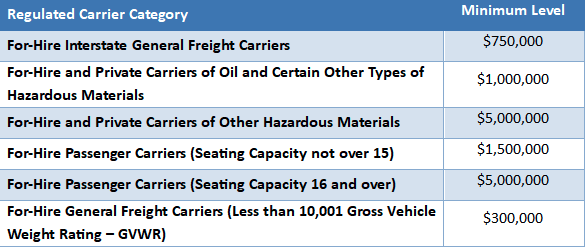
The current minimum financial responsibility levels for motor carriers of property took effect on January 1, 1985, for motor carriers of passengers effective on November 19, 1985. These levels are summarized in the table below.
Effective October 1, 2013, section 32918 of MAP-21 required $75,000 in financial security for brokers and extended the financial security requirement to freight forwarders.
Previous Study
In January 2013, FMCSA funded a study conducted by DOT’s John A. Volpe National Transportation Systems Center (Volpe), titled Financial Responsibility Requirements for Commercial Motor Vehicles. The Volpe study examined whether the minimum financial responsibility requirements should be raised, weighing the benefits of improved compensation for crash victims, internalization of freight and passenger transportation costs, and reductions in truck and bus-involved crashes, against costs imposed on commercial motor vehicle (CMV) operators, the insurance industry, and other relevant considerations.
- Volpe estimated that catastrophic crashes, resulting in injury, death, or property damages that exceeded the current minimum levels of financial responsibility, comprised less than one percent of all CMV crashes.
- The analysis revealed that two categories of injury crash (severe and critical) yield damages of more than $1 million, in nominal terms, using the DOT’s recommended value of a statistical life (VSL) of $6.2 million that was in effect at that time.
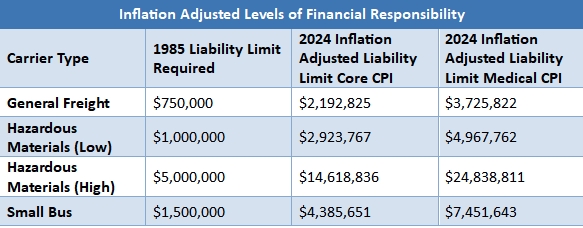
- The decreasing real value of the current minimum levels of financial responsibility is effectively removing the function of insurance in covering catastrophic crashes. From 1985 to 2024, the medical consumer price index (CPI) increased at a significantly higher rate than the core consumer price index (4.21 percent annually for medical care, compared to 2.80 percent for core). In fact, the medical consumer price index has outpaced overall inflation in all but five of those 39 years.
American Transportation Research Institute
More recently, ATRI compiled litigation data for 600 cases between 2006 and 2018. ATRI looked specifically at case information with jury awards over $1 million. Those cases increased by a factor of nine from 2010 to 2013 and the dollar value of cases has also increased. The mean dollar value of jury awards over $1 million between 2006 and 2018 was $3.1 million and the median jury award was $1.75 million. Between 2005 and 2011, there were 79 verdicts over $1 million, while between 2012 and 2019 there were 265 such cases, representing an increase of 235 percent. While the average verdict over the 13-year period between 2006 to 2018 was $3.1 million, the average size of a verdict over the 9-year period from 2010 to 2018 was $22.3 million. The average verdict increased between 36.5 and 37.6 percent faster than inflation or healthcare costs. ATRI asserts the increase in excess of inflation and medical costs implies other unknown factors may be affecting verdict awards.
Conclusion
FMCSA faces persistent challenges in comprehensively evaluating the adequacy of the minimum financial responsibility requirements. Most of the published reports and publicly available data sources on the adequacy of current minimum insurance levels are not subject to frequent revisions. A substantial portion of relevant information remains inaccessible to the Agency due to non-disclosure agreements, and a significant amount of insurance company data is proprietary. Consequently, FMCSA’s ability to provide a thorough assessment of motor carrier financial responsibility requirements is limited. To determine the sufficiency of the financial responsibility requirements, FMCSA would need access to more granular data from the insurance industry, including anonymized claims information at the person-level.

Recent Comments