RESOURCES  |  317-770-0953

News

Compliance and Regulatory Update: August, 2017

Newsletter Update


NTCI eNews Logo
Compliance and Regulatory Update: August, 2017

Crash Preventability

Two Year Pilot Program Announced
Beginning August 1st, for crashes that occurred on or after June 1, 2017, carriers can now request a preventability review. The request will be sent through the DataQs system and should include any information, documentation or video footage that supports categorizing the crash as non-preventable. FMCSA reserves the right to request additional information on the crash, which may include any documentation the carrier is required to maintain under the Agency’s regulations. FMCSA will use the following standard to assess the crash scenario:
“If a driver, who exercises normal judgement and foresight could have foreseen the possibility of the accident that in fact occurred, and avoided it by taking steps within his or her control which would not have risked causing another kind of mishap, the accident was preventable.”


Only crashes of these types are eligible for review:
1. When the CMV was struck by a motorist driving under the influence (or related offense);
2. When the CMV was struck by a motorist driving the wrong direction;
3. When the CMV was struck in the rear;
4. When the CMV was struck while it was legally stopped or parked, including when the vehicle was unattended;
5. When the CMV struck an individual committing or attempting to commit suicide by stepping or driving in front of the CMV;
6. When the CMV sustained disabling damage after striking an animal in the roadway;
7. When the crash was the result of an infrastructure failure, falling trees, rocks, or other debris; or
8. When the CMV was struck by cargo or equipment from another vehicle.
After review, there are three possible decisions:
Not Preventable
The public CSA display will include a notation that reads, ”FMCSA reviewed this crash and determined that it was not preventable.” For logged-in users (motor carriers viewing their own data, FMCSA, and law enforcement users), two Crash Indicator BASIC percentiles will be calculated-one with and one without the not preventable crash(es).
Preventable
The public CSA display will include a notation that reads, ”FMCSA reviewed this crash and determined that it was preventable.”
Undecided
In these cases, the documentation submitted did not allow for a conclusive decision by reviewers. When crash reviews are undecided, SMS will include a notation that reads, ”FMCSA reviewed this crash and could not make a preventability determination based on the evidence provided.”
In addition, if a submitter fails to provide documents requested by FMCSA, the request will be designated in DataQs as ”Closed Due to Non- Response” without any notation in the public CSA display.
Any member of the public with documentation or data to refute the proposed finding will have 30 days to submit the documentation through the DataQs system.

CSA Vehicle Maintenance

Are Incentive Programs the Answer?

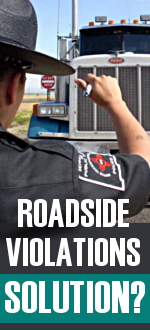
Roadside Violation Solution
When it comes to CSA scores one of the most troublesome BASICs for most carriers is Vehicle Maintenance. Some carriers have begun paying a bonus to drivers if they have a clean roadside inspection. On the other hand, if the inspection has violations, the bonus is not paid.
The merits of this type of incentive have been debated and it’s not likely that there will ever be a consensus. Some say that the pre-trip is an important part of the driver’s job description and a motor carrier should not have to pay extra. Others contend that paying a bonus adds an incentive for the driver to do more than “walk around” the truck before taking off.
The most common roadside inspection violations involve lights, tires and brakes. Most certainly a driver can easily check lights and tires visually. Of course it can be argued that the light in question was working and malfunctioned during the trip. That can happen but it doesn’t explain the high number of lighting violations discovered during roadside inspections.
What about brake violations? Here the situation gets a little more complicated. The driver is not required, nor are they trained, to do a completed brake inspection. This would involve a thorough inspection under the equipment of brake condition and operation, pushrod travel, as well as all of the associated air hoses.
So, what’s the solution to this problem? The answer isn’t simple and the best advice is that motor carriers should craft policies and procedures that fit their operation. In making those decisions the motor carrier should consider:
Ongoing training for drivers regarding pre-trip inspection procedures. Yes, they all studied this when they took their CDL exam, but training is not a one-time event.
Ongoing training for the mechanics who perform  maintenance on your equipment. It’s important to provide feedback to them about the types of roadside inspection violations and their frequency. This feedback is necessary regardless of whether you have your own shop or use an outside vendor.
Management support.  FMCSA requires an annual inspection of equipment, but that’s the regulatory minimum. If the goal is to reduce maintenance problems and violations then equipment should be inspected more frequently. Also, if a driver discovers a problem during a pre-trip, what procedures are in place to assist the driver in getting repairs completed before the trip begins? What will the dispatcher’s reaction be if the driver says they’ll be delayed while repairs are being completed?
This is not to say that incentives have no role to play in this process, but it’s important to realize that reducing vehicle maintenance violations is a process that touches all parts of the motor carrier’s operation.

CVSA Brake Safety

Single Day Event This Year

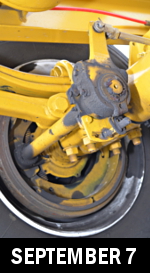
Brake Check Sept 7 2017
Thursday, Sept. 7, 2017, is Brake Safety Day, an enforcement and compliance campaign where law enforcement agencies across North America will conduct inspections on large trucks and buses to identify out-of-adjustment brakes, and brake-system and antilock braking system (ABS) violations as part of the Commercial Vehicle Safety Alliance’s (CVSA) Operation Airbrake Program.
The goal of Brake Safety Day is to reduce the number of crashes caused by poorly maintained braking systems on commercial motor vehicles (CMVs) by conducting roadside mechanical fitness inspections.Brake-related violations comprised the largest percentage (representing 45.7 percent) of all out-of-service violations cited during Operation Airbrake’s companion  Roadcheck campaign.
On Brake Safety Day, inspectors will primarily conduct the North American Standard Level I Inspection, which is a 37-step procedure that includes an examination of both driver operating requirements and vehicle mechanical fitness. Inspections conducted will include inspection of brake-system components to identify loose or missing parts, air or hydraulic fluid leaks, worn linings, pads, drums or rotors, and other faulty brake-system components. ABS malfunction indicator lamps are also checked. Inspectors will measure pushrod stroke, where applicable. Vehicles with defective or out-of-adjustment brakes will be placed out of service.
Furthermore, in the 10 jurisdictions using performance-based brake testing (PBBT) equipment, vehicle braking efficiency will be measured. PBBT systems include a slow speed roller dynamometer that measures total vehicle weight and total brake force from which braking efficiency is determined. The minimum braking efficiency for trucks is 43.5 percent, required by U.S. federal regulation and the CVSA out-of-service criteria.
This year’s Sept. 7 Brake Safety Day follows up on CVSA’s May 3, 2017, unannounced Brake Safety Day and replaces the seven-day Brake Safety Week campaign from previous years.

You can count on us to provide expert guidance to keep your safety and compliance programs on track.

Ryan Billet
National Transportation Consultants, Inc.
317-770-0953
National Transportation Consultants, Inc., 400 Lafayette Road, Noblesville, IN 46060
Sent by rbillet@ntconsult.com in collaboration with
Constant Contact